

Choosing between pneumatic and electric diaphragm pumps is one of the most consequential decisions in industrial fluid handling. This complete guide analyses the operating principles, performance metrics, energy efficiency, maintenance requirements and installation considerations for both pump types. Pneumatic diaphragm pumps excel in hazardous environments thanks to their spark-free operation and chemical resistance, while electric diaphragm pumps deliver precise flow control and up to five times greater energy efficiency compared to air-operated alternatives. By examining flow rates, pressure capabilities, fluid compatibility and real-world application scenarios, from car wash facilities and municipal cleaning to industrial chemical processing, this guide provides the technical foundation for confident pump selection in any professional context. Emiltec offers both technologies, represented by the FLOJET G57 and the SHURFLO Triplex Membrane series, ensuring the right fluid handling equipment for every operational requirement.
A diaphragm pump is a positive-displacement device that transfers fluid through the alternating flexion of a flexible membrane, the diaphragm. As the membrane moves outward, it creates a partial vacuum that draws fluid in through the inlet valve; as it moves inward, it pressurises the chamber and forces the fluid out through the outlet valve. This operating principle differs fundamentally from centrifugal and plunger pumps, conferring diaphragm pumps with a set of unique characteristics that make them particularly well-suited to demanding fluid handling scenarios.
The most important of these characteristics are their self-priming capability and their ability to run dry without sustaining damage. These two properties, confirmed across the entire Emiltec diaphragm pump range, dramatically simplify installation and operation, eliminating the foot valves, priming chambers and dry-run protection devices that would otherwise be required. Combined with the use of materials selected to withstand a wide range of chemicals, diaphragm pumps become some of the most versatile pieces of fluid handling equipment available to industrial operators.
The power source, compressed air or electric motor, defines the two main families of diaphragm pumps available on the market and determines their suitability for different environments, applications and operational budgets.
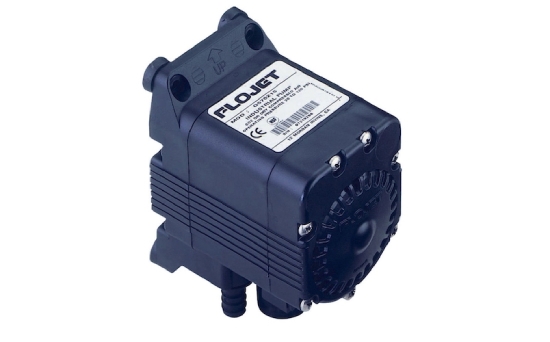
Pneumatic diaphragm pumps, also known as air-operated diaphragm (AOD) pumps, use compressed air as their driving force. Compressed air alternately pressurises one side of the diaphragm and then the other, creating the reciprocating motion that drives the pumping cycle. In double-diaphragm configurations, such as the FLOJET G57 offered by Emiltec, two diaphragms work in opposition, so that while one is on its compression stroke the other is on its suction stroke, producing a smoother and more continuous flow than a single-diaphragm design would allow.
The FLOJET G57 double diaphragm pneumatic pump distributed by Emiltec features a santoprene membrane and valve, a polypropylene body and hastelloy springs, a combination of materials that delivers excellent chemical resistance across a broad spectrum of industrial fluids. Its air-driven design makes installation straightforward: no electrical wiring is required, meaning the pump can be deployed quickly wherever a compressed air supply is available.
The applications addressed by pneumatic diaphragm pumps within the Emiltec ecosystem include foam brush systems in car wash facilities, presoak dispensing, tyre cleaner delivery, and general chemical transfer operations, all contexts where the absence of electrical components in the fluid-handling zone is a practical or regulatory advantage.
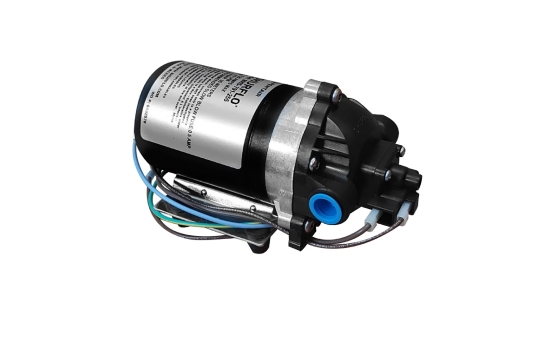
An electric diaphragm pump replaces compressed air with an electric motor as the driving force. The motor drives a mechanical linkage that imparts the reciprocating motion to the diaphragm, eliminating the need for a compressed air infrastructure entirely. The result is a self-contained unit that can be deployed wherever electrical power is available.
Emiltec distributes the SHURFLO Triplex Membrane electric diaphragm pump, which incorporates a santoprene membrane and a built-in pressure switch for automated operation and precise flow control. The pressure switch allows the pump to start and stop automatically in response to system pressure, enabling efficient operation in spray applications, chemical dispensing systems and circulation loops without the need for manual intervention.
Like the FLOJET G57, the SHURFLO Triplex Membrane is constructed from materials selected to withstand a wide range of chemicals, shares the same self-priming capability and dry-run tolerance, and is suitable for the same range of liquid transfer tasks: spray applications, cooling, circulation, filtration and dispensing.
Understanding how the two pump types compare across the parameters that matter most to industrial operators is the foundation of sound pump selection. The following analysis covers the principal performance dimensions.
Energy efficiency is one of the most significant differentiators between the two technologies. Electric diaphragm pumps can reduce energy consumption by up to five times compared to air-operated alternatives. This difference stems from the inherent inefficiency of compressed air as an energy carrier: compressors consume significant electrical power, and the distribution network introduces pressure losses before the air reaches the pump. An electric diaphragm pump, by contrast, converts electrical energy directly into mechanical motion, eliminating these intermediate losses and delivering substantially lower operating costs over the equipment's service life.
For facilities operating pumps continuously or for extended daily periods, such as industrial cleaning operations or car wash installations, this efficiency advantage translates into meaningful reductions in electricity bills and a measurably lower environmental footprint.
Electric diaphragm pumps offer superior precision in flow rate management. The pressure-switch technology integrated into the SHURFLO Triplex Membrane enables automated start and stop cycles, maintaining consistent system pressure without operator involvement. Advanced electric diaphragm pumps can also incorporate variable frequency drive (VFD) technology, which allows precise adjustment of flow rate to match process requirements in real time.
Pneumatic diaphragm pumps provide a simpler form of self-regulation: the flow rate can be adjusted by varying the air supply pressure, and the pump will stop automatically when the outlet is closed, resuming operation as soon as the valve is reopened. This behaviour makes pneumatic pumps inherently safe against deadhead conditions, a valuable property in unattended or remote deployments.
Both pump types in the Emiltec range are built from materials selected to handle a broad range of chemical products. The santoprene membranes and valves of the FLOJET G57 and the SHURFLO Triplex Membrane offer excellent resistance to the detergents, alkaline cleaners, acids and foam compounds used throughout professional cleaning, car wash and municipal applications. The polypropylene body of the FLOJET G57 and the hastelloy springs further extend its chemical compatibility to include more aggressive media.
Both diaphragm pumps are self-priming and capable of running dry without damage, making them tolerant of the supply interruptions and intermittent operation patterns common in professional cleaning environments.
Pneumatic pumps produce a characteristic exhaust noise as compressed air cycles through the pump. Electric diaphragm pumps operate significantly more quietly, a relevant factor for installations in noise-sensitive environments such as indoor car wash facilities, food processing areas or public municipal buildings.
|
Parameter |
Pneumatic diaphragm pump (FLOJET G57) |
Electric diaphragm pump (SHURFLO Triplex) |
|
Power source |
Compressed air |
Electric motor |
|
Energy efficiency |
Lower (compressor losses) |
Up to 5× more efficient than AOD |
|
Flow control |
Via air pressure regulation |
Pressure switch; VFD-compatible |
|
Self-priming |
Yes |
Yes |
|
Dry-run capability |
Yes, without damage |
Yes, without damage |
|
Chemical resistance |
Excellent (santoprene, PP, hastelloy) |
Excellent (santoprene) |
|
Noise level |
Higher (air exhaust) |
Lower (electric motor) |
|
Installation |
Requires compressed air supply |
Requires electrical supply |
|
Hazardous area suitability |
High (no electrical components in fluid zone) |
Subject to ATEX certification requirements |
|
Automated operation |
Self-regulating on outlet restriction |
Integrated pressure switch |
Diaphragm pumps find extensive use across the professional and industrial sectors that form the core of Emiltec's application portfolio. Understanding which pump type is better suited to each context is essential for making the right pump selection decision.
Car wash facilities are one of the primary application environments for both pump types. Electric diaphragm pumps with integrated pressure switches are ideal for the chemical dispensing systems in automated wash bays, where consistent dosing of detergents, waxes and rinse aids must be maintained throughout a continuous operating cycle. The energy efficiency of electric models reduces the running costs of high-throughput facilities. Pneumatic diaphragm pumps are well-suited to foam brush delivery and presoak dispensing points where a compressed air supply is already present and electrical installation would add complexity.
Municipal cleaning applications, street washing, surface preparation, public infrastructure maintenance, often take place in outdoor or semi-outdoor environments where the conditions are less controlled. The robustness of both pump types, their chemical resistance and their dry-run tolerance make them reliable choices for mobile municipal cleaning units. Where electrical power is not readily available, pneumatic pumps powered by the vehicle's air system offer a practical solution.
Industrial cleaning covers a wide spectrum of operations, from chemical dosing in production lines to the supply of foaming and spraying systems integrated with high-pressure washing equipment. Both pump types integrate seamlessly with the Venturi injectors, chemical filters, foam lances and dosing equipment in the Emiltec spraying and foaming range, enabling the construction of comprehensive fluid handling systems tailored to the specific demands of each industrial environment. For detailed information on the full range of compatible accessories, see the Emiltec spraying and foaming product section.
Wherever industrial processes require the controlled transfer of chemical products — from storage tanks to dosing points, from mixing vessels to spray systems — diaphragm pumps provide a reliable and chemically compatible solution. Their gentle pumping action, which avoids the high shear forces of centrifugal designs, makes them suitable even for shear-sensitive formulations. The self-priming capability eliminates the need for auxiliary equipment at the tank outlet, simplifying system design and reducing installation costs.
One of the defining strengths of diaphragm pumps as a category of fluid handling equipment is their simplicity. With no rotating shaft seals and no mechanical contact between the fluid and the drive mechanism, the number of wear components is limited. The diaphragm and the inlet and outlet valve elements are the primary service items in both pneumatic and electric models.
For pneumatic diaphragm pumps, the compressed air supply system, filter, regulator and lubricator, must also be maintained to ensure clean, dry air reaches the pump. Contaminated or wet air accelerates wear of the internal air distribution valve and reduces the service life of the diaphragm. Regular inspection of the air treatment equipment is therefore an integral part of the maintenance programme for pneumatic pump installations.
Electric diaphragm pumps do not require air treatment infrastructure, simplifying the maintenance scope. The motor and pressure switch should be inspected periodically to verify correct operation. The pressure switch setting may require adjustment over time to maintain the intended start and stop pressure differential.
In both cases, the diaphragm material, santoprene in both the FLOJET G57 and the SHURFLO Triplex Membrane, is selected for long-term chemical resistance and mechanical durability. Emiltec provides spare parts and technical support for both pump families, ensuring that maintenance can be carried out promptly and that the service life of the equipment is maximised.
The infrastructure requirements of the two pump types represent one of the most practical dimensions of the pump selection decision. A facility that already has a compressed air network can deploy a pneumatic diaphragm pump with minimal additional investment: connection to the existing air supply and a short fluid circuit are all that is required, with no electrical work needed in the pump's immediate vicinity. This makes pneumatic pumps the faster and often cheaper option to install in contexts where compressed air is available.
Where no compressed air network exists, installing one solely to power a diaphragm pump adds significant capital cost and ongoing compressor maintenance to the total cost of ownership. In this scenario, an electric diaphragm pump offers a more economical installation path: connection to the mains supply and integration into the control circuit via the built-in pressure switch are sufficient to create a fully automated dosing or transfer system.
Both pump types require the fluid inlet to be positioned to allow the self-priming mechanism to function correctly. Although diaphragm pumps have good suction lift capability, keeping the inlet line as short and direct as possible minimises the work required during priming and ensures consistent performance. Both the FLOJET G57 and the SHURFLO Triplex Membrane can handle the liquid transfer, spray, cooling, circulation, filtration and dispensing tasks typical of the professional cleaning and industrial environments served by Emiltec.
To explore the full selection of both pump models and their technical specifications, visit the dedicated pneumatic and electric diaphragm pumps page on the Emiltec website.
Making the right choice between a pneumatic diaphragm pump and an electric diaphragm pump requires a structured evaluation of the specific operational context. The following considerations provide a practical framework for the decision.
Emiltec's technical team is available to support customers in evaluating these criteria and identifying the most appropriate diaphragm pump model for their specific requirements.
Both pneumatic and electric diaphragm pumps are designed to integrate naturally within complete spraying and foaming systems. At Emiltec, the diaphragm pump range is part of a broader family of spraying and foaming components that includes Venturi injectors, chemical injection filters, foam lances, dosing pumps, sprayers and foamers. This integration capability is central to the value proposition: rather than selecting a pump in isolation, operators can configure a complete fluid handling system, from chemical storage through dosing and delivery to the final spray application, using compatible, professionally selected components from a single supplier.
This system's approach is particularly valuable in car wash facilities, where the interaction between chemical concentrations, water flow rates and spray patterns directly determines cleaning quality and operating economics. It is equally relevant in municipal and industrial cleaning contexts, where the pump must work reliably within a broader equipment ecosystem under demanding daily operating conditions.
For a full view of how diaphragm pumps fit within the complete range of Emiltec's spraying and foaming solutions, including foam lances, Venturi injectors and chemical filters, explore the spraying and foaming section of the Emiltec product catalogue.
Both pneumatic and electric diaphragm pumps are proven, reliable technologies for industrial fluid handling. Their shared characteristics, self-priming operation, dry-run capability and broad chemical compatibility, make them versatile choices across the professional cleaning, car wash, municipal and industrial sectors that Emiltec serves. The choice between the two comes down to the specific conditions of each installation: the available infrastructure, the energy efficiency requirements, the degree of flow automation needed and the noise environment.
The FLOJET G57 pneumatic double diaphragm pump delivers chemical resistance, simple installation and self-regulating behaviour ideal for environments with an existing compressed air supply. The SHURFLO Triplex Membrane electric diaphragm pump provides automated pressure control, superior energy efficiency and quieter operation for facilities served by electrical infrastructure. Together, they cover the full range of professional diaphragm pump requirements within the Emiltec catalogue, backed by the same commitment to quality and technical support that characterises the entire product offering.
Understanding these distinctions, as this guide has set out to do, is the essential first step towards a pump selection decision that delivers consistent performance, low operating costs and long equipment service life across any industrial application.



 Digital Marketing